
Are you learning Chinese with Anki?

Put your flashcards into context.

Pindu extends Anki's spaced repetition system with an extensive reading engine to help you build reading comprehension and vocabulary. Build text from your Anki collection, then get credit for reading it.

Free Anki add-on, no account needed
400+ learners using Pindu
"So powerful for learning!" — Anki add-on review
"You have created an amazing tool." — Chinese-Forums
"Progress has increased significantly." — Anki add-on review

How Pindu Works

Pindu integrates with Anki as an alternative review mode. Read passages at your level and get credit for all words automatically.

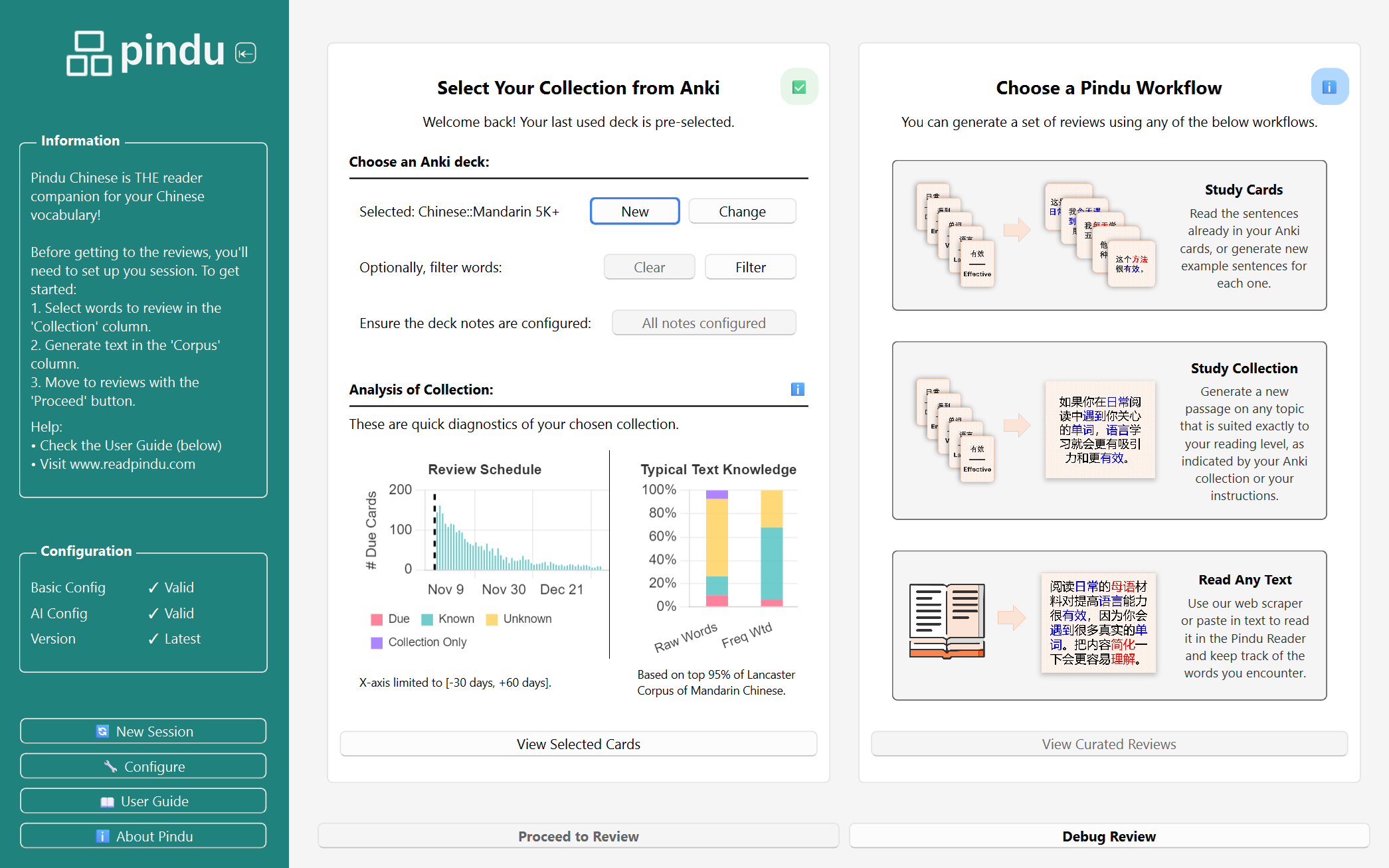
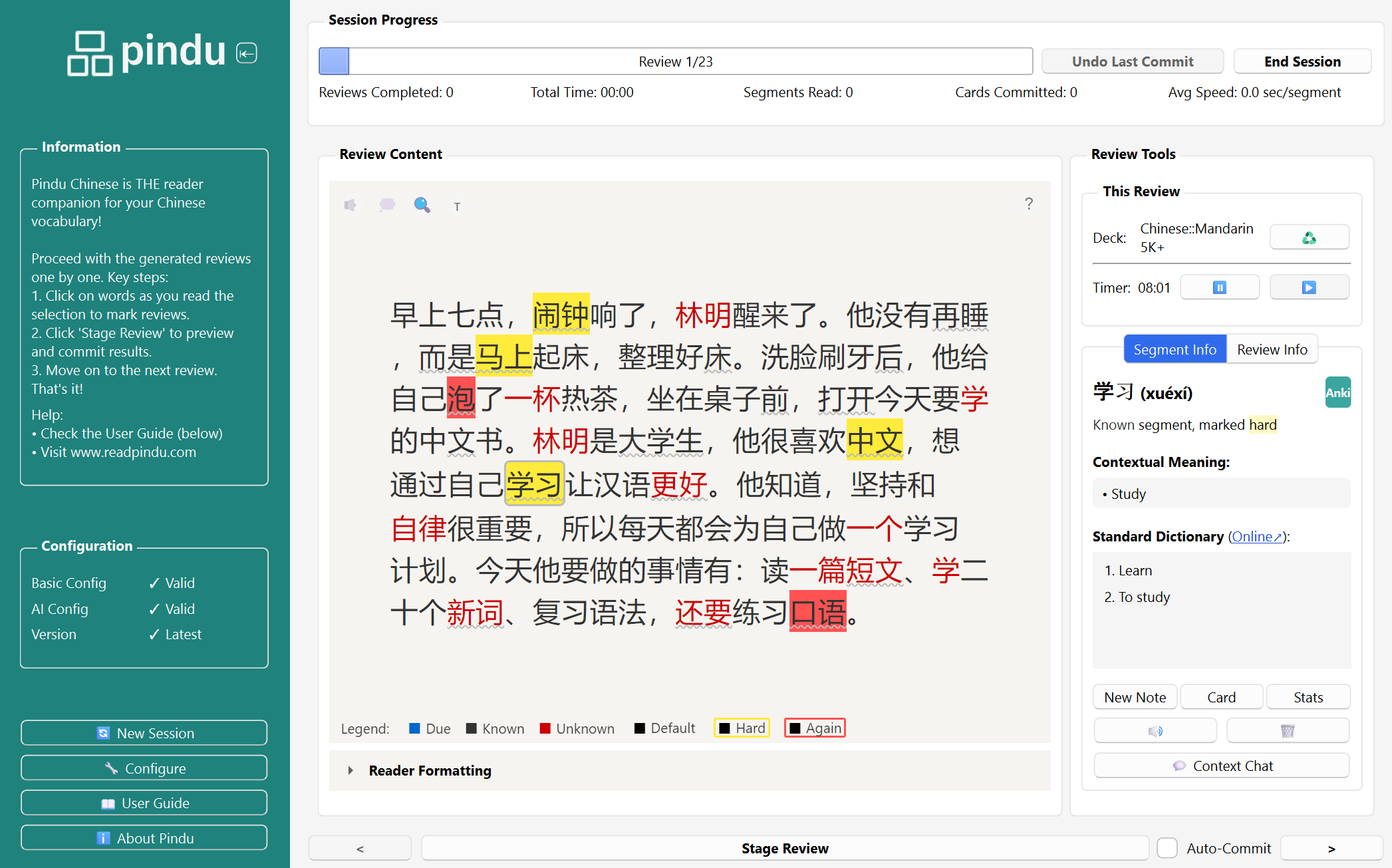
How Pindu works: Load your Anki deck, build a text passage with Pindu, then log reviews by marking words as you read

See Pindu in Action

Get started in 4 steps

  1. Visit the Anki add-on page

    Navigate to AnkiWeb's shared add-ons

  2. Download Pindu

    Click "Download" and copy the add-on code

  3. Install in Anki

    Open Anki, go to Tools → Add-ons → Get Add-ons, and paste the code

  4. Launch Pindu

    Restart Anki and find Pindu in your tools menu
Features

Get SRS credit while reading

Get SRS credit while reading

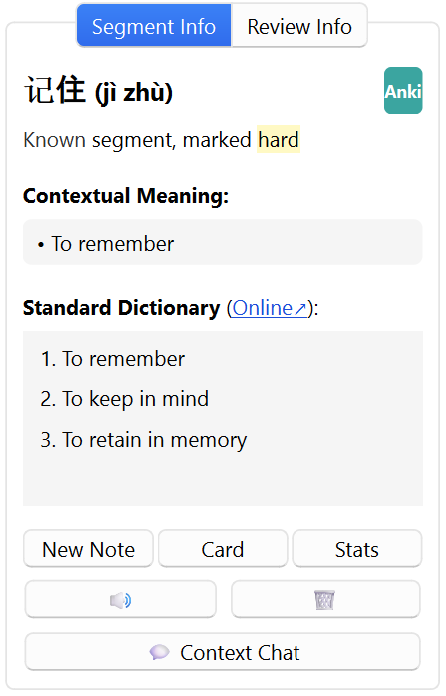
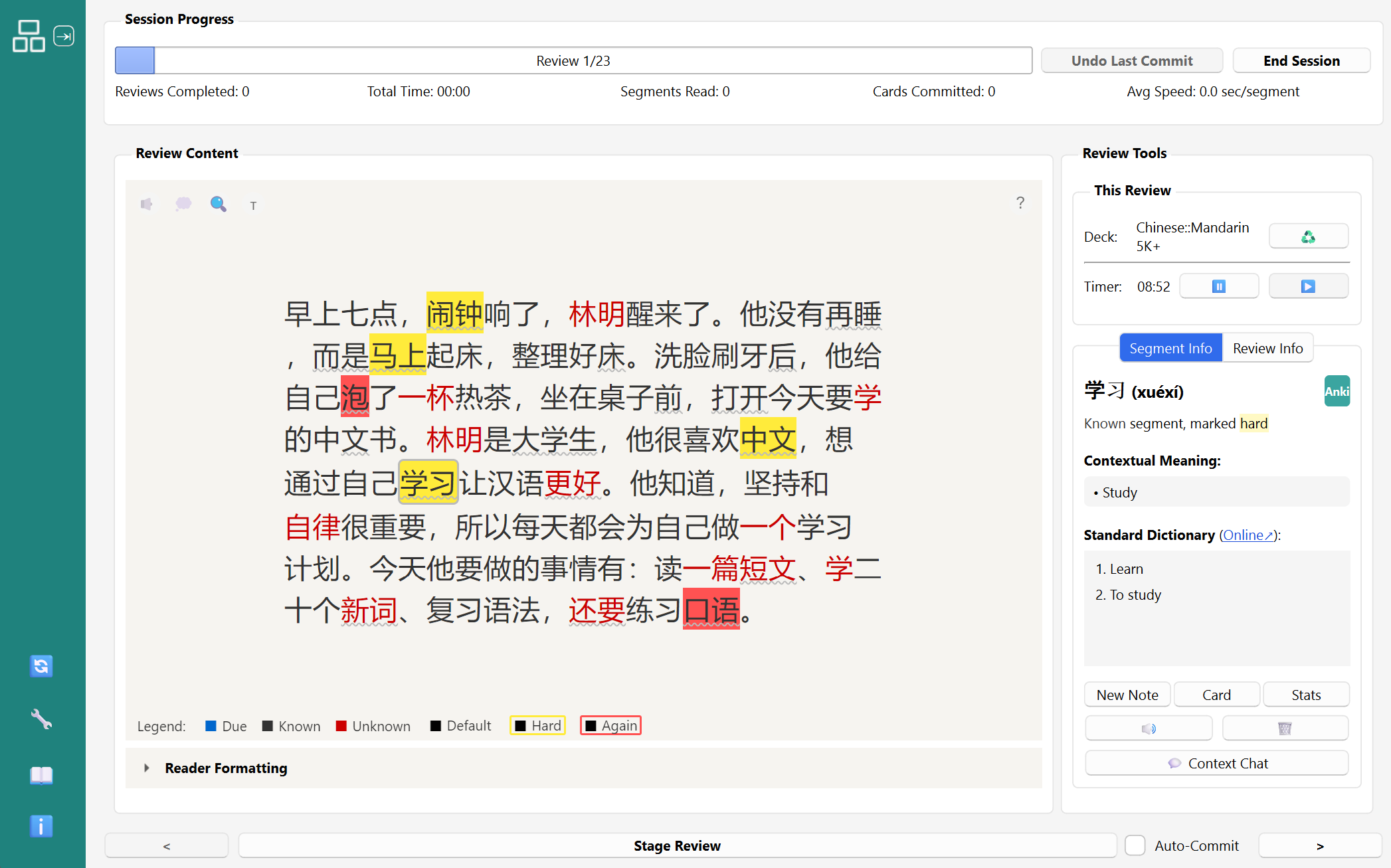
Pindu facilitates convenient text mark-up to capture word-specific SRS reviews while you read through target language passages. Studying vocabulary words becomes a byproduct of understanding full sentences and paragraphs.

Generate and optimize text

Generate and optimize text for extensive reading

Pindu constructs personalized passages that optimize your reading practice by leveraging recent breakthroughs in LLMs. Maximize the frequency of words you're about to forget while keeping comprehensibility over 95% and reading about a topic you care about. (Or bring your own text instead!)

Integrated language services

Integrated language services

Pindu integrates fast dictionary lookups, text-to-speech for passages and words, LLM-based tutor chat, and more. Look up definitions, translate sentences, understand grammar, and add new words to your collection without leaving your reading flow.

Full Anki integration

Full Anki integration

Pindu was built to complement and extend Anki, not to replace it. Switch back and forth between Pindu and Anki "Classic" in the same session, do one or the other first, or skip one entirely: all your work will compound regardless.

Questions and Answers

We see the Pindu approach as an exciting fusion of traditional language acquisition methods. It is heavily inspired by both (a) spaced-repetition flashcard systems (e.g., Anki) for efficient vocabulary acquisition and maintenance and (b) graded readers (e.g. Sinolingua's excellent Chinese readers) for personalized reading. Pindu takes advantage of modern computing horsepower and AI models to take these systems to the next level.

Anki is excellent at what it does, but isolated flashcard review has real limits as your deck grows. Other technology-forward solutions in the space cluster around augmenting the reading experience for existing texts (e.g. LingQ, ReadLang, Kimchi Reader) or improving the UI and UX of vocabulary review (e.g. Hack Chinese). For the research behind why combining SRS with extensive reading is more effective than either alone, see our research post The Science of Extensive Reading.

Pindu currently supports Chinese only. We're planning support for Japanese, Korean, Spanish, and other popular languages based on user demand.

Which language are you learning? Email us to vote for the next language, or join our email list to get notified when new languages launch.

Pindu is built for conscientious self-learners who prefer direct approaches over gamification. If you're comfortable with Anki's spaced repetition system and want to extend it to extensive reading practice, Pindu is designed for you.

Pindu focuses on measurable progress through Anki's proven spaced repetition system rather than points, streaks, or leaderboards. Your motivation comes from real reading fluency gains, not artificial rewards. If you're wondering how to integrate it with your current Anki habit, Getting Started covers the first-week experience in detail.

Pindu uses advanced language models to create reading content that naturally incorporates your due vocabulary words. It considers factors like your current level, the number of words you're reviewing, and your chosen topics of interest. Crucially, passages are calibrated so that ~90% of the words you encounter are ones you know well — keeping you in Nation's "extensive reading zone" where incidental vocabulary acquisition happens. For a technical walkthrough of the full session pipeline, see How Pindu Works.

We think so. Language modeling is the single core competency of modern-day Large Language Models. In our experience, LLMs excel at generating "descriptively correct" text, i.e. choosing normal words for a situation and using them according to their normal senses. While you may not encounter archaic and rare usages unless you specifically ask for them, we see that as a plus for the vast majority of language learners.

Pindu (品读, pǐn dú) means something like "to savor reading" in Chinese. The character 品 represents "tasting" or "savoring," which neatly captures the sense of satisfaction we take from language learning. We have gone through a few naming iterations ("BeyondVocab" and "Mosaic") but Pindu feels right.